

Deterministic evaluation. Same input, same score, every time.
Turn requirements quality control from a matter of judgment into something you can measure. Every requirement is scored 1–5 against your organization's exact standards, directly in the tool where it was written. Every finding is traceable to the words that triggered it, so engineers can see exactly what is wrong, why it matters, and fix it before a defect becomes part of the system.
Independence is structural, not a promise, because evaluation is never the same mechanism as generation.
While a command is rejected, when the [TIME: ___ seconds] time interval elapses, the CF shall issue an error event message.
What QVscribe assures
The score does not move with the author or the reviewer. It is a property of the requirement itself, which means a finding can be used as evidence rather than argued in review. Requirements are rated 1 to 5 as they are written, every finding maps to the exact text that triggered it and names the rule it broke. Re-analysis focuses on what changed, so feedback keeps pace with authoring.
Your phrase rules, controlled vocabulary, units, and organizational standards, alongside EARS and INCOSE conformance. Four shipped profiles provide different levels of analysis for different document types, while your own configurations can be maintained at the company or program level. Each configuration is versioned, so the standard being applied is explicit and traceable.
A requirement can score well on its own and still conflict with one written 300 requirements further down. Cross-requirement analysis surfaces near-duplicates, overlaps, and potential contradictions between requirements that were each approved on their own terms. Assurance of a sentence is a smaller claim than assurance of the specification.
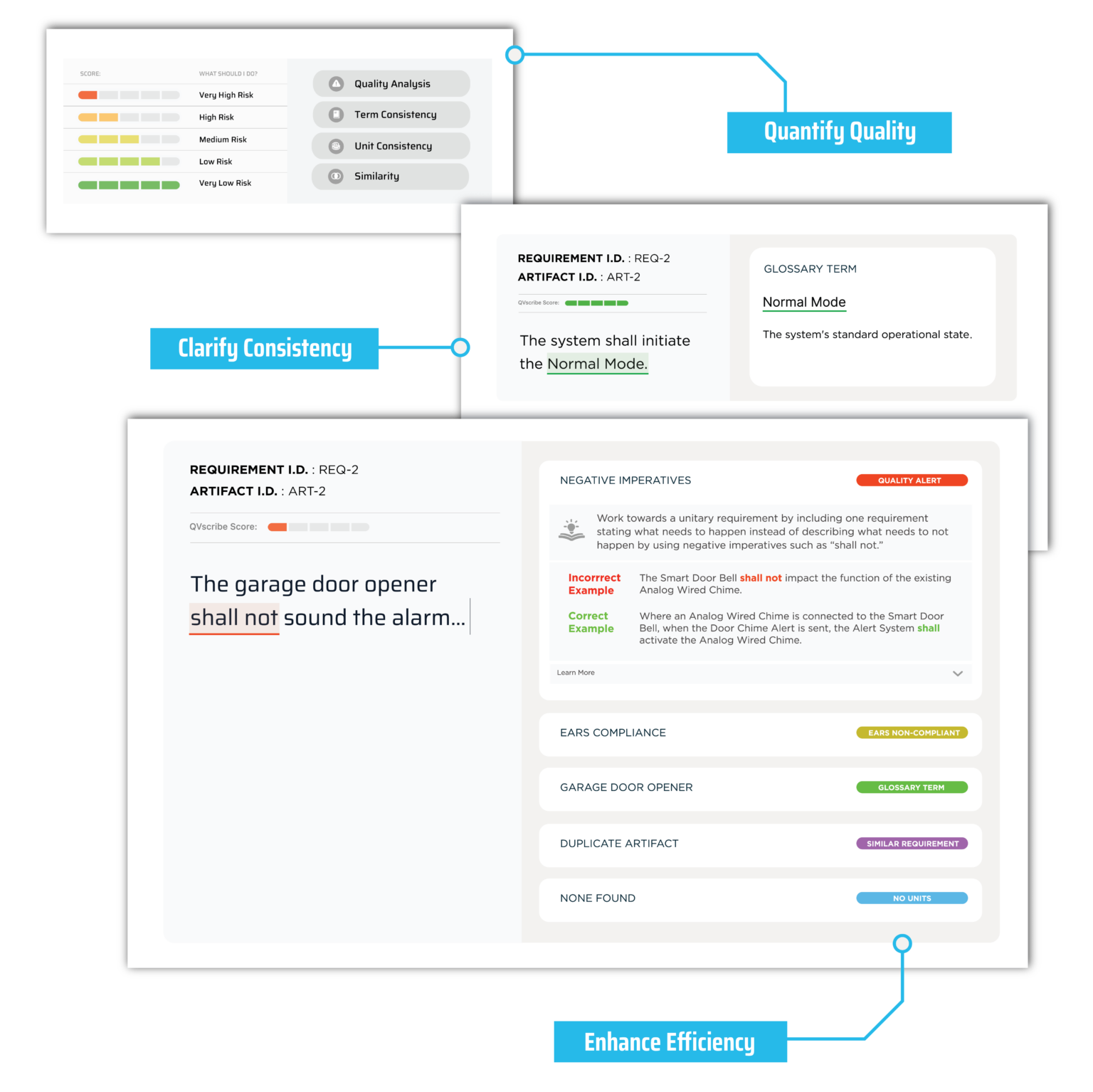
Every point on the scale traces to a named Problem Type.
Every check has a name, and every finding cites it. Problem Types can be enabled or excluded by configuration, with exclusion prefixes for text the analysis should skip. Nothing about the score is a black box. A score you cannot decompose is a preference.
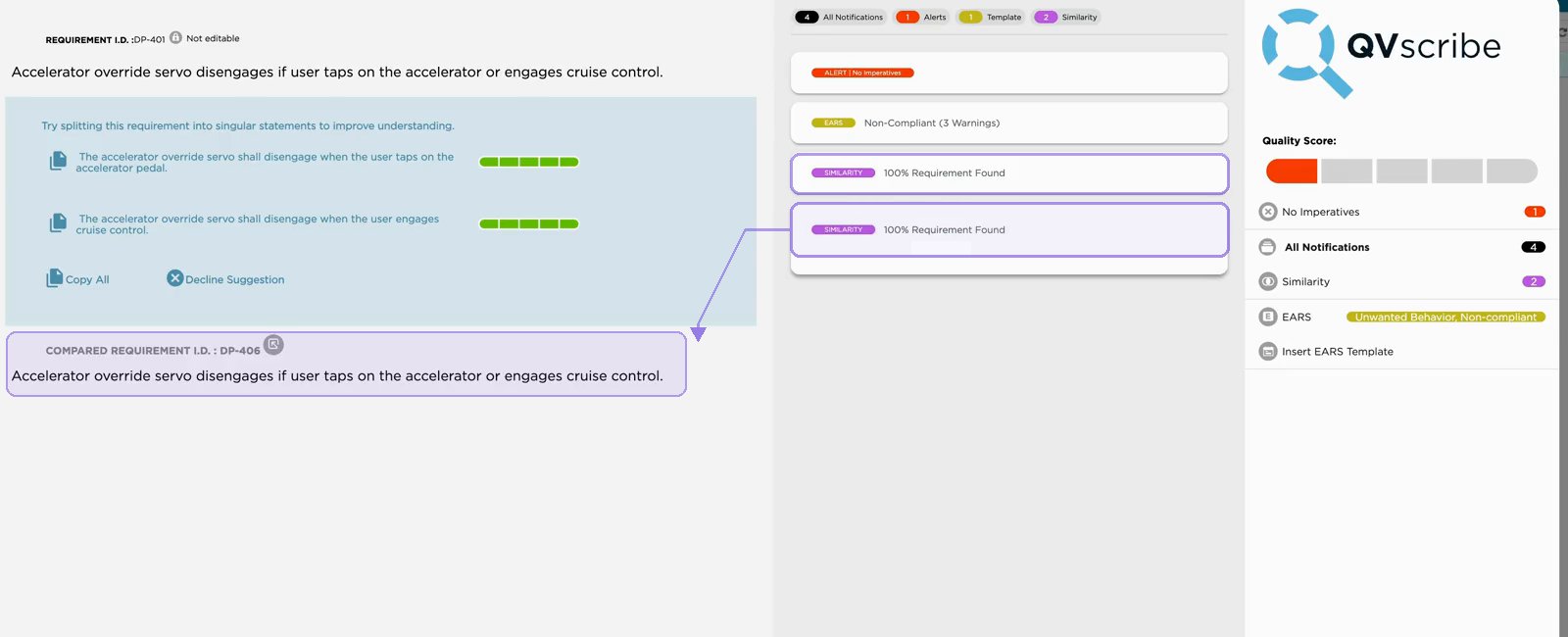
When CF receives a “Transfer File” command, if the command specified is open, CF rejects the command.
- No Imperatives · alert: “rejects” states a fact. Nothing in the sentence obligates anyone — an imperative such as “shall” must be included, and none was found. The missing word has no underline, because the problem is that it is missing.
- Passive Voice · warning (“specified”): specified by whom? The actor is hidden.
- EARS, non-compliant · 4 warnings: ‘when’ and ‘if’ cannot share one requirement, and the ‘if’ is never followed by ‘then’.
Where the problem is a word, the finding points at it. Where the problem is a missing word, the finding says what is missing. Fix them and the score moves. The record of what was scored under which configuration stays on the QRA Platform.
Clarity and Ambiguity
- Vague wording
- Passive voice
- Cross-referencing pronouns
- Continuances
- Superfluous infinitives
Measurability and Testability
- Immeasurable quantification
- Universal quantifiers
- Non-specific temporal words
- Optional escape clauses
- Open-ended clauses
Structure and Well-Formedness
- Incomplete sentences
- No imperatives
- Multiple imperatives
- Negative imperatives
- Directives
- Justification mixed into text
Consistency
- Unit consistency
- Glossary conformance
Checked across your requirement set: controlled vocabulary, units, and near-duplicate detection.
EARS and INCOSE conformance are built in. When EARS templates are enabled, requirements are held to a small set of constrained sentence patterns and non-conforming ones are flagged. The same rules can carry from authoring through rewriting.
No migration, no new system of record, no export step before review.
QVscribe works where the requirements already live, with the same configuration applied across every surface. The standard does not change with the tool.
Word and Excel
A task-pane add-in for Microsoft Word and Excel. Mark requirements in the document, analyze them, see scores and problems highlighted in place, and capture a snapshot of the scored state.
Your requirements management platform
A Chrome and Edge extension that overlays analysis directly inside IBM DOORS Next, Siemens Polarion, and Jama Connect.
The web interface
Requirement editors and suggestion review for work that does not start in a document or a platform.
The QVscribe API
The same analysis, the same configurations, and the same scoring over a RESTful interface, for environments the extension does not cover and for work that never passes through a human editor at all. Ask us about the API →
A team that moves between surfaces keeps its standard. Going from Word to the extension inside your requirements platform changes where requirements live, not what they are held to.
The rewrite suggested here is not the one another run would produce, and that is by design. ReqWriter drafts vary, and if one does not suit you, run it again for another. What does not vary is the judge: every draft is scored against the same configuration, so the score tells you whether the concern is gone.
Before QVscribe touches your requirements.
Security and procurement teams need to know what QVscribe can access, where analysis happens, and who controls the rules. Here is the short version.
How QVscribe accesses your requirements
- Sync uses the engineer's existing authenticated session. No API keys and no service accounts in your systems of record.
- It inherits the engineer's exact permissions and can never surface a requirement they could not already open.
- QVscribe sync is read-only and never writes back to the source. Rewrites are applied by the engineer, in their own session, when accepted.
Where analysis runs
- Analysis runs in QRA's cloud. Requirement content is copied there for analysis. We would rather you read that here than discover it in a security review.
- The add-in and extension run in the engineer's environment and connect to QRA's cloud for analysis.
- Data residency: in-region hosting is supported.
- An on-premises version of QVscribe is also available. What fits your environment best is a conversation: book a call.
Who controls access and authority
- Enterprise single sign-on: Azure AD B2C, OIDC, LDAP, and Active Directory.
- Tenant isolation is default-deny at every layer, including authentication, data queries, cache keys, and event streams.
- Authority is separated. The person writing requirements is not the person who can change what counts as a good one.
Compliance. The platform is developed against the OWASP Top 10. QRA maintains ISO 27001-compliant practices and is pursuing full certification.
Deployment specifics beyond this depend on your environment. Your reviewer is welcome at the demo.
Precise beats impressive.
QVscribe evaluates individual requirements against your standard, and checks consistency across your requirement set: controlled vocabulary, units, near-duplicates. Today, completeness is a different job, and so is reconciling requirements against architectures, models, tests or code.
QVscribe flags it. ReqWriter proposes a rewrite. You decide.
When a requirement scores poorly, ReqWriter proposes a rewrite beside the original, with every change marked. You can accept, reject, or edit the changes before anything is applied.
You choose the rules ReqWriter writes to and the rules QVscribe scores against. They can be the same rules, but they are never the same mechanism. ReqWriter proposes. The score comes from an engine that had no hand in the rewrite, so you can see whether the fix actually improved the requirement or simply changed the wording.
Every environment is different. Book a call to see how ReqWriter can fit in yours.
The record stays with it.
The QRA Platform keeps the history.
Every snapshot captures the requirement text, the score, the configuration version, the rule set, and the engine version behind it. Run the same analysis under the same configuration next year and you get the same result.
That gives you a record you can use in a design history file, against a milestone gate, or when an auditor asks what standard was applied and whether the document met it. Snapshots build into timelines, so you can see how quality changes across a sprint, a program, or a portfolio.
Every environment is different. Book a call to see how the QRA Platform can fit in yours.
Common questions about QVscribe.
The short answers.
What is QVscribe?
QVscribe is the requirements evaluation engine of the QRA Platform. It scores engineering requirements for clarity, consistency, and quality in Microsoft Word and Excel through a task-pane add-in, inside IBM DOORS Next, Siemens Polarion, and Jama Connect through a browser extension, and in the web interface.
What does deterministic evaluation mean?
Deterministic requirements evaluation means that the same requirement, under the same configuration, receives the same score and findings every time. This applies across Word, Excel, supported requirements platforms, and the web interface.
What is behind a score?
Every QVscribe score, rated from 1 to 5, is built from named Problem Types. Each finding identifies the rule that triggered it and the exact words involved, so engineers can understand why a requirement received its score and what to fix. The record also retains the configuration version and engine version behind each result, so the score can be explained later.
What are Problem Types, and who defines them?
QVscribe’s built-in Problem Types are grounded in INCOSE guidance on well-formed requirements, with EARS conformance checks available alongside them. You can add your own approved glossary terms, and configurations let you set the review criteria using built-in levels or customized versions.
Can we use our own writing standards?
Yes. QVscribe configurations are named and versioned, and can include your rules, approved glossary terms, and units. Built-in EARS conformance checks cover individual EARS templates, allowing requirements to be evaluated against your organization’s standards rather than a fixed rubric.
Can QVscribe analyze requirements in bulk?
Yes. QVscribe supports bulk requirements analysis, evaluating entire documents and requirement sets in one pass. It scores each requirement and checks for similarities across the set.
How do we know scores are consistent across teams and sites?
QVscribe uses deterministic scoring and versioned configurations. The same requirement, under the same configuration version, receives the same score for every engineer across supported surfaces. This gives teams a consistent basis for discussing requirements quality, regardless of who performs the evaluation.
What is the difference between a warning and a failing score?
Findings that make a requirement unverifiable lower the score. Warnings do not lower the score; they flag something for the engineer’s judgment. A warning may warrant investigation without necessarily indicating that the requirement is wrong. Both findings and warnings identify the words that triggered them.
Does QVscribe change our requirements?
No. QVscribe evaluates requirements but does not rewrite them. ReqWriter provides rewrite suggestions, and an engineer decides whether to accept each change.
Why does a low score matter if the requirement reads fine?
A requirement can read well and still fail at verification. It might lack an imperative, contain an escape clause, or use a term that cannot be measured in a test. QVscribe identifies the specific problem, giving the engineer a clear basis for deciding what to fix.
What if we use a different requirements management tool?
QVscribe has direct integrations for Microsoft Word and Excel, IBM DOORS Next, Siemens Polarion, and Jama Connect. Teams using other requirements management systems can often analyze their requirements through Word or Excel. Book a call to discuss your setup.
See your own requirements scored.
A working session on a document you actually care about, with your standard encoded as a configuration.
The QRA Signal
Where Continuous Engineering Assurance goes next: new capabilities and the Requirements Operating Model as it releases, plus the chance to shape the roadmap, every two weeks. Not ready to talk? Start here.