

From Point-in-Time to Lifecycle Intelligence with Snapshots
Snapshots and Timelines now capture the exact state of each requirement the moment a snapshot is taken, giving engineering teams a precise, timestamped record of how requirements evolve across the full project lifecycle.
Requirements quality isn’t static. It changes with every review cycle, design gate, and team handoff. Without a structured record of where requirements stood at key moments, teams are left relying on memory instead of data. Teams can now track what changed, when it changed, and whether quality is improving, at the requirement granularity, module layer, and across programs.
Applies to: QRAcloud Portal
Requirement-Level Snapshot Capture
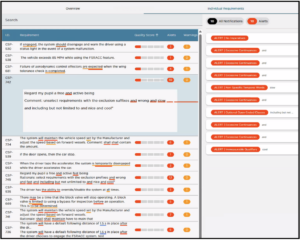
Previously, Snapshots were only at the document level, leaving gaps in visibility. Now, Snapshots and Timelines record the version of each requirement at the moment a snapshot is taken. Authors and reviewers can navigate back to any prior snapshot and see exactly what a requirement looked like, its text, score, and quality flags.
This creates a defensible record for design reviews, regulatory submissions, and internal audits, without manual documentation overhead.
Milestone Gate Benchmarking
Engineering programs have natural quality checkpoints, but most teams lack a structured way to track requirement quality across these gates. Snapshots let teams capture a quality baseline at each milestone and track improvement or regression.
Across multiple programs, this builds a longitudinal dataset that turns requirement quality into a measurable, reportable metric instead of a subjective judgment.
Leadership and Program Visibility
Program managers and engineering leadership need high-level insights without diving into individual documents. Snapshot data surfaces quality trends at the project and portfolio level, allowing leadership to quickly see what matters, whether requirement health is improving, which modules carry the most risk, and whether teams are on track for release.
This transforms QVscribe into a program-level quality reporting layer accessible to stakeholders at every level.
Reusable Quality Baselines Across Programs
High-quality requirement sets are hard to build and easy to degrade. Snapshots let teams certify a known-good baseline, a set of requirements that meets internal quality standards, and reuse it across programs.
Teams inheriting requirements from prior programs can immediately compare against the baseline, reducing review effort and providing a concrete quality target.
Audit and Compliance Traceability
In regulated industries, demonstrating requirement quality at the time of submission is mandatory. Snapshots provide a timestamped, immutable record of requirement state at any captured moment. Teams can answer auditor questions about design freeze states, scores, and changes without manual versioning or exports.
Faster Deviation Detection
Requirement quality can degrade silently between reviews. By comparing Snapshots over time, teams can identify regressions, detect declining quality dimensions, and spot rework risks early.
Earlier detection means smaller corrections, fewer downstream issues, and more predictable project outcomes.